

The 2026 EdTech Compliance Roadmap: SOC 2, Student Privacy, and AI Regulation
TL;DR : EdTech vendors selling to K-12 and higher education institutions in 2026 must navigate three compliance layers: SOC 2 Type II audits for operational security proof, state-specific "super laws" like Illinois SOPPA and NY Education Law 2-d (requiring data privacy agreements and NIST alignment), and new AI governance mandates across Indiana, Kentucky, and Rhode Island that introduce universal opt-out mechanisms and neural data protections. The strategic advantage lies in "mapping once, complying many"—SOC 2 Security criteria overlap 40-50% with state requirements, reducing duplicate compliance work when paired with automation platforms like Drata or Vanta.
The student data privacy landscape has fundamentally shifted. School districts no longer accept vendor self-attestation. Instead, they demand three things:
Third-party validation through SOC 2 Type II reports
State-specific Data Privacy Agreements (DPAs)
Proof that AI algorithms don't violate automated decision-making laws
Why SOC 2 is Now Mandatory for EdTech?
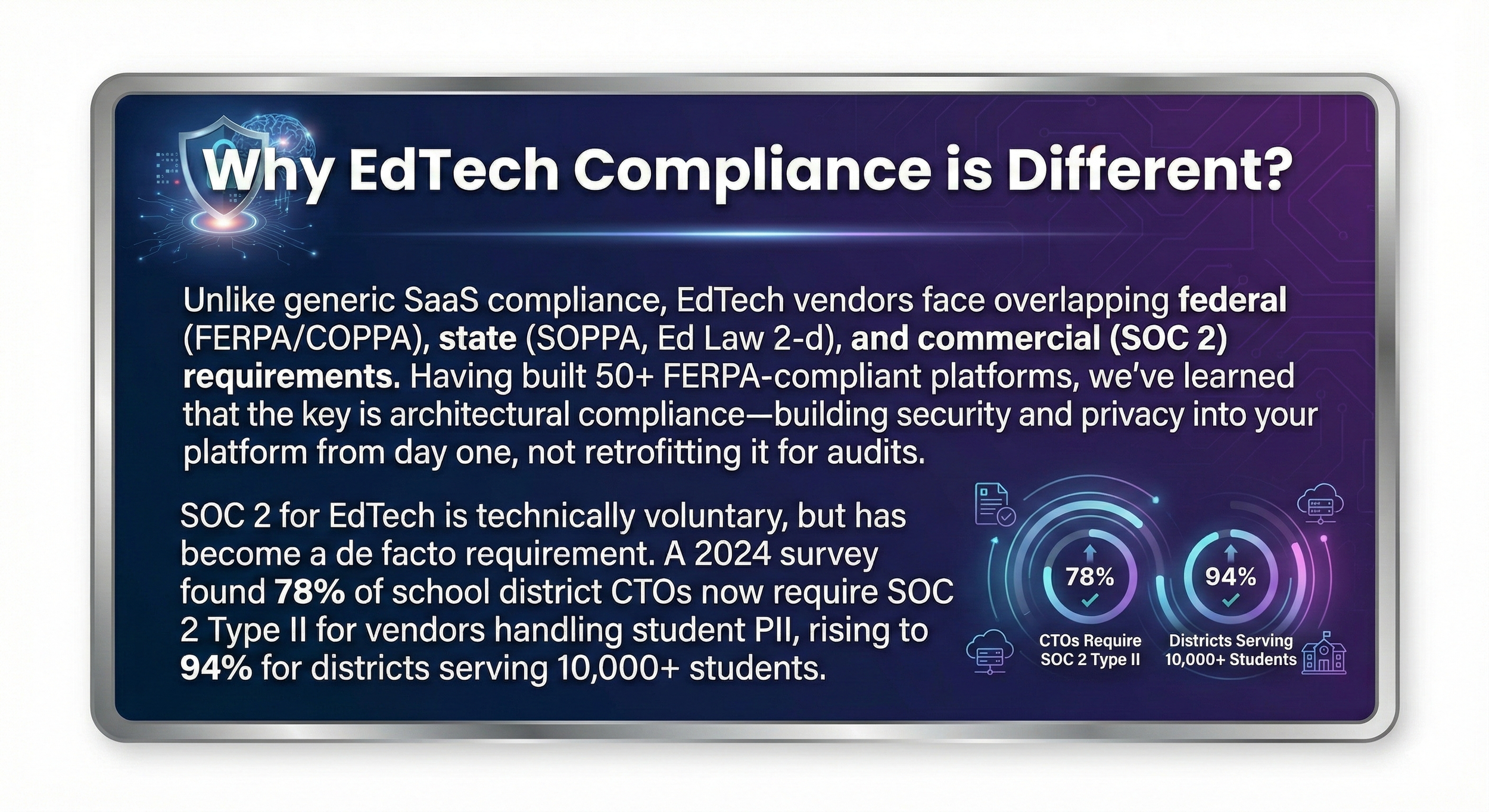
To stay competitive, the short answer is yes. SOC 2 may be technically voluntary, but it has become a de facto requirement.CoSN's 2024 survey shows cybersecurity as the top priority for 99% of EdTech leaders, driving vendor security scrutiny like SOC 2 for PII-handling tools.
Type 1 vs. Type 2: Type 1 evaluates controls at a point in time (6-8 weeks, $5k-$25k). Type 2 measures operational effectiveness over 3-12 months and is now the standard for EdTech vendors.
|
Expense Category |
Bootstrapped Startup (<20 employees) | Funded Company (20-100 employees) |
|---|---|---|
| Auditor Fees | $15,000 - $25,000 | $25,000 - $50,000 |
| Compliance Platform (annual) | $6,000 - $12,000 | $15,000 - $30,000 |
| Internal Labor (100-400 hours) | $10,000 - $40,000 | $40,000 - $80,000 |
| Remediation Costs | $2,000 - $10,000 | $5,000 - $20,000 |
| Total Year 1 | $33,000 - $87,000 | $85,000 - $180,000 |
Hidden costs: Year 2+ renewals require auditor fees ($12k-$30k annually) plus ongoing platform subscriptions. Don't wait for prospects to ask—the 3-12 month observation period means you need to start implementing controls well before closing enterprise deals.
Need help implementing SOC 2 controls while building your EdTech platform? Hireplicity's engineering teams have supported 50+ EdTech companies, including learning management systems, student information platforms, and assessment tools serving districts from 5,000 to 500,000+ students through FERPA, COPPA, and SOC 2 compliance implementations.
Contact our team to discuss your compliance roadmap.
State-Specific "Super Laws" (SOPPA, Ed Law 2-d, SB 820)
Federal FERPA establishes the baseline, but states have passed their own legislation creating specific contractual and technical obligations.
Illinois SOPPA (Student Online Personal Protection Act)
Every EdTech vendor must execute written Data Privacy Agreements (DPAs) with each district specifying data categories collected, retention periods, subcontractors, and breach notification procedures. The Student Data Privacy Consortium (SDPC) provides standardized templates.
Prohibited practices: Targeted advertising profiles, selling student data, using data beyond contracted educational purposes, or retaining data longer than necessary.
Breach notification: 30-day timeline to notify districts, who then notify parents.
New York Education Law 2-d
NY mandates alignment with the NIST Cybersecurity Framework (Identify, Protect, Detect, Respond, Recover). This creates a natural bridge to SOC 2—Security criteria map directly to NIST's Protect and Detect functions.
Key requirements:
Parents' Bill of Rights in every contract
Encryption of data in transit (TLS 1.2+) and at rest (AES-256)
Subcontractor flow-down provisions extending obligations to cloud providers, analytics tools, etc.
Texas SB 820: Cybersecurity for School Districts
Vendors must align with district cybersecurity policies (typically based on Texas Cybersecurity Framework). Every district has a Cybersecurity Coordinator requiring immediate breach notification with 48-hour reporting to the Texas Education Agency.
|
Requirement |
SOPPA (IL) | Ed Law 2-d (NY) | SB 820 (TX) | SOC 2 Control Mapping |
|---|---|---|---|---|
| Data Privacy Agreement | Required | Required | Recommended | CC6.6 (Confidentiality) |
| Encryption (Rest/Transit) | Required | Required (explicit) | Required | CC6.7 (Confidentiality) |
| Access Controls | Required | Required (NIST) | Required | CC6.1, CC6.2 |
| Breach Notification | 30 days | Immediate | Immediate | CC7.3, CC7.4 (Incident response) |
| Subcontractor Management | Listed in DPA | Flow-down clauses | District alignment | CC9.2 (Vendor management) |
| Data Retention/Deletion | In DPA | In contract | In contract | PI1.4 (Privacy) |
By prioritizing the creation of the SOC 2 control matrix before choosing automation platforms, our clients have successfully reduced their total compliance implementation time by 20-30%. This approach provides clear insight into the exact integration requirements needed for successful deployment.
The 2026 Privacy Landscape: New Laws & Universal Opt-Outs
Three comprehensive state privacy laws take effect on January 1, 2026: the Indiana Consumer Data Protection Act (INCDPA), the Kentucky Consumer Data Protection Act (KCDPA), and the Rhode Island Data Transparency and Privacy Act (RIDTPPA). All require data protection assessments, consumer rights (access, correct, delete), and opt-out requirements.
Universal Opt-Out Mechanisms: Global Privacy Control (GPC)
Four states now require businesses to honor Global Privacy Control (GPC) signals: Oregon, Connecticut, Colorado, and Rhode Island. When users enable GPC in their browser, it sends a Sec-GPC: 1 header with every request.
Technical requirements:
Detect the GPC signal via HTTP header or JavaScript API
Honor it as a valid opt-out for data sales and targeted advertising
Persist the preference across sessions without requiring accounts
The conservative approach for EdTech: Respect GPC by disabling all optional tracking and document your interpretation in your privacy policy.
Compliance strategy: Build to California CCPA/CPRA standards (the strictest baseline), implement GPC universally, and add state-specific contractual language to DPAs as needed. This "highest common denominator" approach reduces engineering complexity and legal risk.
Compliance Automation: Reducing Timeline from 12 Months to 4
Compliance automation platforms integrate with your cloud infrastructure, SaaS tools, and HR systems to automatically monitor controls, collect evidence, and generate audit packages. This shifts compliance from periodic scrambles to continuous posture management.
|
Platform |
Best For | Starting Cost | Key Differentiator |
|---|---|---|---|
| Drata | High-growth startups | $12,000 - $24,000/year | Deepest integrations (90+ tools) |
|
Vanta |
Series A+ companies | $12,000 - $30,000/year | Fastest time-to-SOC 2 (3-4 months) |
| Secureframe | End-to-end support | $10,000 - $25,000/year | Includes auditor referrals |
| Sprinto | Bootstrapped teams | $6,000 - $15,000/year | Best price-to-feature ratio |
| Scrut | Multi-framework needs | $8,000 - $18,000/year | Strong ISO 27001 support |
ROI Example (30-person EdTech startup):
Manual approach: $70,000 total, 12-month timeline
Automated approach: $41,500 total, 4-month timeline
Savings: $28,500 (41%) and 8 months
The automated approach provides ongoing value—continuous monitoring means you're always audit-ready. Most startups pair a platform with a part-time vCISO (5-10 hours/month, $5k-$15k total) for strategic guidance.
Hireplicity's Compliance-Driven Development Approach:
Rather than treating compliance as a separate initiative after product development, we integrate SOC 2 controls and state privacy requirements into your application architecture, database design, and deployment pipelines. This means when audit time comes, your platform is inherently compliant and just not scrambling to meet requirements.
Strategic Recommendations for 2026
1. Map Controls Once, Comply Many Times
Aligning EdTech compliance efforts across frameworks significantly boosts efficiency. For example, the SOC 2 Security criteria have substantial overlap: 40-50% with state requirements, 60-70% with ISO 27001, and considerable overlap with NIST.
By creating a unified controls matrix that maps each technical control to all relevant frameworks, you can achieve major time savings. Implementing a single control, such as Multi-Factor Authentication (MFA), can simultaneously satisfy SOC 2 CC6.1, NIST standards, and state-law requirements. This integrated approach can reduce total implementation time by an estimated 30-40%.
2. Add SOC 2 Privacy Criteria for EdTech
While most SaaS companies focus solely on Security criteria, EdTech companies should include privacy criteria (an estimated $2k-$5k additional cost). This provides audited evidence of data privacy practices—specifically addressing notice, consent, retention, and individual rights—which directly aligns with FERPA and various state Data Protection Authority (DPA) requirements.
3. Build AI Governance into Processing Integrity
As AI features proliferate, incorporate algorithmic validation into SOC 2 Processing Integrity criteria: model validation testing, bias detection, version control, and drift monitoring. This creates comprehensive attestation: "We have third-party validation of security, privacy, AND algorithmic accuracy."
4. Embrace Continuous Compliance
Move away from an urgent "scramble for the audit" mindset and instead embed security directly into your development lifecycle. Implement continuous compliance practices: conduct quarterly mock audits, manage your platforms with the same rigor as infrastructure, and integrate engineering teams into compliance decision-making. This shift ensures you are perpetually prepared for RFPs and removes audit timelines as a bottleneck to business progress.
5. Leverage Compliance for Differentiation
Establish public trust centers, streamline responses to security questionnaires, and create compliance-focused marketing case studies. Strategically position your offering as "the only [category] with SOC 2 Privacy and Processing Integrity attestation." By making compliance verification effortless, you eliminate the friction that hinders competitors.
Common Compliance Mistakes EdTech Startups Make
Waiting Until Procurement Asks: Waiting to begin the SOC 2 process only when a school district makes the request ensures you will forfeit the deal, due to the required 3–12 month observation period. Instead, initiate SOC 2 at least six months before commencing enterprise sales efforts.
Treating Compliance as IT-Only: Compliance shouldn't be solely owned by IT. To prevent missing critical vendor contracts and HR policies, engage legal, HR, and product teams from the start.
Choosing Platform Over Strategy: While tools like Vanta or Drata streamline evidence collection for compliance, they are not a substitute for compliance itself. You still require expertise in control design and risk assessment to achieve it.
When SOC 2 Alone Isn't Enough
SOC 2 doesn't automatically satisfy every compliance requirement. You'll still need:
COPPA Compliance for under-13 users: Parental consent mechanisms, limited data collection
WCAG 2.1 Level AA accessibility: Screen reader compatibility, keyboard navigation
State-specific certifications: Some states (e.g., Louisiana) have vendor approval processes beyond SOC 2
If your platform serves special education (IDEA-covered students) or handles health data (school nurses, counseling), you may need additional compliance frameworks like HIPAA.
Frequenty Asked Questions
-
No, SOC 2 is voluntary. However, 78% of school district CTOs now require SOC 2 Type II for vendors handling student PII (94% for districts serving 10,000+ students). It's the de facto commercial requirement for enterprise EdTech sales.
-
Yes. Most startups use a compliance automation platform (Drata, Vanta, Sprinto) plus a part-time vCISO. Expect 100-150 internal hours plus $6k-$15k for vCISO support during your 3-4 month audit preparation.
-
FERPA is a federal law protecting student records that applies to schools, not vendors. SOC 2 provides the technical evidence that your security methods meet FERPA's "reasonable methods" standard for vendor data protection.
-
For startups under 50 employees: $33,000-$87,000 in Year 1 (auditor $15k-$25k, platform $6k-$12k, labor $10k-$40k, remediation $2k-$10k). Year 2+ renewals drop to $20k-$45k.
-
Yes. Several 2026 state laws mandate GPC support; the technical lift is modest, and it demonstrates privacy-forward thinking. Many EdTech platforms have consumer-facing components (parent portals, teacher tools) that clearly fall under consumer privacy law scope.
Conclusion: Building Compliance as Competitive Advantage
For EdTech companies in 2026, compliance is a strategic imperative, not just a risk. The regulatory landscape demands proactive measures including SOC 2 Type II audits, state-specific Data Processing Agreements (DPAs), NIST alignment, universal opt-out mechanisms, and transparent AI governance. By managing these requirements strategically, compliance transcends simple risk mitigation to become a powerful market differentiator that builds trust and drives revenue growth.
EdTech companies that thrive embrace continuous compliance as an operational discipline, map controls strategically across frameworks, invest in automation, position compliance as a trust-builder, and build security into product architecture from day one.
Treat compliance as the foundational element for enterprise growth, ensuring you start the process early and allocate a realistic budget. Securing contracts with districts hinges on earning their trust, which is achieved by demonstrating a shared commitment to student data protection through third-party attestation.
Ready to build a compliance-ready EdTech infrastructure? Hireplicity has 16+ years of experience helping EdTech companies implement FERPA/COPPA-compliant architectures, SOC 2 controls, and state privacy requirements. Contact us to discuss your compliance and development roadmap.