

Onshore vs. Offshore vs. Nearshore: The Definitive 2026 Decision Framework for Founders & CTOs
Featured Article
SIS vs LMS: Which System Owns Your Product's Data?
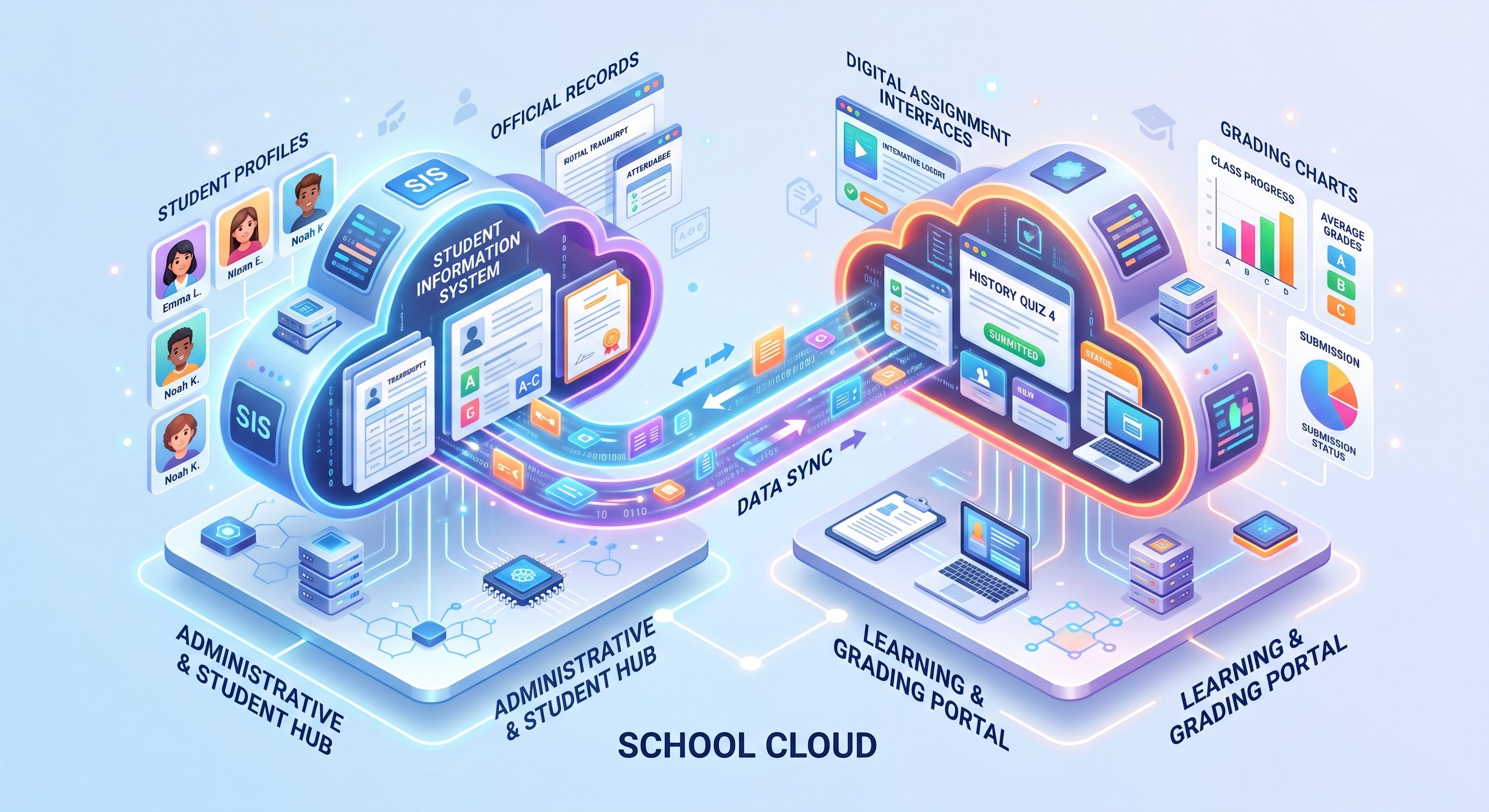
The SIS vs LMS difference comes down to records: a student information system (SIS) is the system of record for enrollment, schedules, attendance, and final grades, while a learning management system (LMS) runs instruction, assignments, and working scores. For EdTech products, rosters flow down from the SIS through 1EdTech's OneRoster standard, and scores flow up through LTI Assignment and Grade Services into the LMS gradebook, not the SIS. Google Classroom, which holds 31% of active K-12 LMS implementations, isn't directly compatible with LTI tools, so it needs its own integration.

Monitoring Vibe-Coded Apps: Catch Silent Failures Early for Founders
Monitoring a vibe-coded app means proving the user's path still works, not just that the server responds. Columbia University's DAPLab built more than 15 applications across five AI coding agents and found error handling and business logic to be the most serious and common failure patterns, and both fail silently while the app keeps returning a normal 200 OK. Reliable coverage runs in four layers: server checks every 30 to 60 seconds, response-shape checks on key endpoints, scripted browser journeys through your revenue paths, and a recurring reconciliation that confirms the business recorded what the customer actually did.

Student Data Tokenization: Stop Copying the Whole Roster
Student data tokenization replaces district-issued student identifiers with opaque values your platform generates, so a copy of your database identifies nobody. It matters because bulk rostering under OneRoster transfers a complete district data set that overwrites the last one, and because the FTC's June 2026 order against Illuminate Education requires that company to delete student data it does not reasonably need and to stop collecting more. EdTech vendors shrink breach scope and shorten district security review by moving from bulk CSV sync to delta sync, to live API reads, and finally to tokenized identifiers.
Student-Centered EdTech UX/UI: Design Considerations for Learning Products
Student-centered EdTech UX/UI design evaluates usability alongside instructional goals. Task speed can matter, but it should not be optimized at the expense of comprehension, accessibility, engagement, or the learning activity’s intended outcome. It differs from standard SaaS design in four measurable ways: it protects working memory instead of minimizing clicks, it splits one interface across developmental age bands, it treats WCAG 2.2 accessibility as a build input rather than a pre-launch audit, and it validates in classrooms rather than labs. NN/g recommends touch targets of at least 2 cm by 2 cm for young children and describes this as four times its 1 cm by 1 cm recommendation for adult users. Treat this as NN/g usability guidance, not a WCAG requirement or universal clinical standard.
The Risks of Building Software With AI (And How to Ship Anyway)
The main risk of building software with AI is not that the code fails, but that it works while nobody can explain how. A scan of 5,600 production applications built with AI tools found more than 2,000 high-impact vulnerabilities, over 400 exposed secrets, and 175 cases of leaked personal data including medical and bank details (Escape, 2026). Better prompting does not close this gap, because the failures are judgment calls rather than missing instructions, so the practical move is to identify which parts of your system a named person can actually explain and treat the rest as risk.
De-Identified Student Data Under FERPA: What the Rule Requires
FERPA lacks a fixed identifier removal list for de-identification. Under § 99.31(b)(1), de-identification requires stripping PII and determining that a student is reasonably unidentifiable across single or multiple releases, accounting for other accessible information. Under 34 CFR § 99.31(b)(1), records count as de-identified only when the releasing party makes a reasonable determination that a student's identity is not personally identifiable, judged across single or multiple releases and against other reasonably available information. A 2019 Nature Communications study modeled re-identification risk and reported that 15 demographic attributes could correctly re-identify 99.98% of Americans in its analysis. The study concerned broader demographic datasets, not FERPA records specifically, so use it as a privacy-risk illustration rather than as proof that every student dataset can be re-identified.
The EdTech COPPA Compliance Checklist: What to Verify in 2026 & 2027
The FTC's amended COPPA Rule reached its compliance date on April 22, 2026, ending a transition period that began when the amendments took effect on June 23, 2025. Among the most important new requirements are separate verifiable parental consent before disclosing a child’s personal information to non-integral third parties, a written retention policy disclosed in the online notice, and expanded coverage of biometric and government-issued identifiers. COPPA violations may result in civil penalties of up to $53,088 per violation, although the number of violations and final penalty amount depend on the facts and the court’s determination.

How Long Does It Take to Build an Offshore EdTech Team? A Realistic Timeline
With a partner that has pre-vetted, available talent, staff-augmentation onboarding can take roughly 2 to 4 weeks from signed agreement to an active sprint. Timing varies by role seniority, interview availability, security-access requirements, jurisdiction, and whether the partner is staffing from an existing bench or launching a new search. Many U.S. K–12 systems operate on July 1–June 30 fiscal years, but district and university budget cycles, board calendars, and procurement schedules vary by state and institution. Confirm the timeline for each target customer rather than planning around a presumed national buying calendar. If you hire offshore developers who have never shipped FERPA-aware, LTI-integrated, accessible software, you pay for that gap later, at the worst possible moment.

Why AI-Generated Apps Break in Production
AI-generated apps break in production because AI coding tools optimize for code that works once, and every property that matters at scale (batched queries, indexes, connection reuse, backpressure) is invisible in a single-user test. New Relic's 2026 State of AI Coding report found 94% of technology leaders rate AI-generated code as higher quality than human-written code at review time, while 82% experienced at least one production failure tied to AI-generated code in the previous six months (New Relic, June 2026). The failures cluster in four places: the database, the request path, the perimeter, and the codebase's own ability to be repaired.

How to Build an Offshore EdTech Team in the Philippines - Your 2027 Guide
An offshore EdTech team in the Philippines needs four capability zones, not one: platform engineering, learning design, compliance and accessibility, and learning data. Beyond developers, the roles that decide whether an EdTech product actually sells are instructional designers (₱440,277 to ₱755,830 per year), LMS administrators (₱533,796 to ₱938,957 per year), and accessibility QA specialists, per 2026 ERI SalaryExpert survey data. Two U.S. regulatory dates now govern what that team has to ship: the amended COPPA Rule's compliance deadline passed on April 22, 2026, and ADA Title II entities must meet WCAG 2.1 Level AA by April 26, 2027.